My Quin Story & Admin Mentioned in FQ Article Published in Nature Journal.

It is promising that such a prestigious journal covered the controversy of the FQ’s.

 Admin
Admin
It is promising that such a prestigious journal covered the controversy of the FQ’s.

To those who are new to my plight or are unfamiliar with my personal situation, my life is delineated with a clear demarcation line. The life before taking Levaquin, a fluoroquinolone (FQ) antibiotic, and my life after. My healthy life before and my not so healthy life after. It is my story, my quin story, my life after Levaquin; Extremely healthy in one season, and a struggle with health the next.

After so many unremarkable tests, and so many years, some of the bigger pieces of the puzzle, for me, are starting to fall into place.

So the next time someone asks you ‘Why are these drugs still on the market?” even though you may not agree, you will at least know the answer.
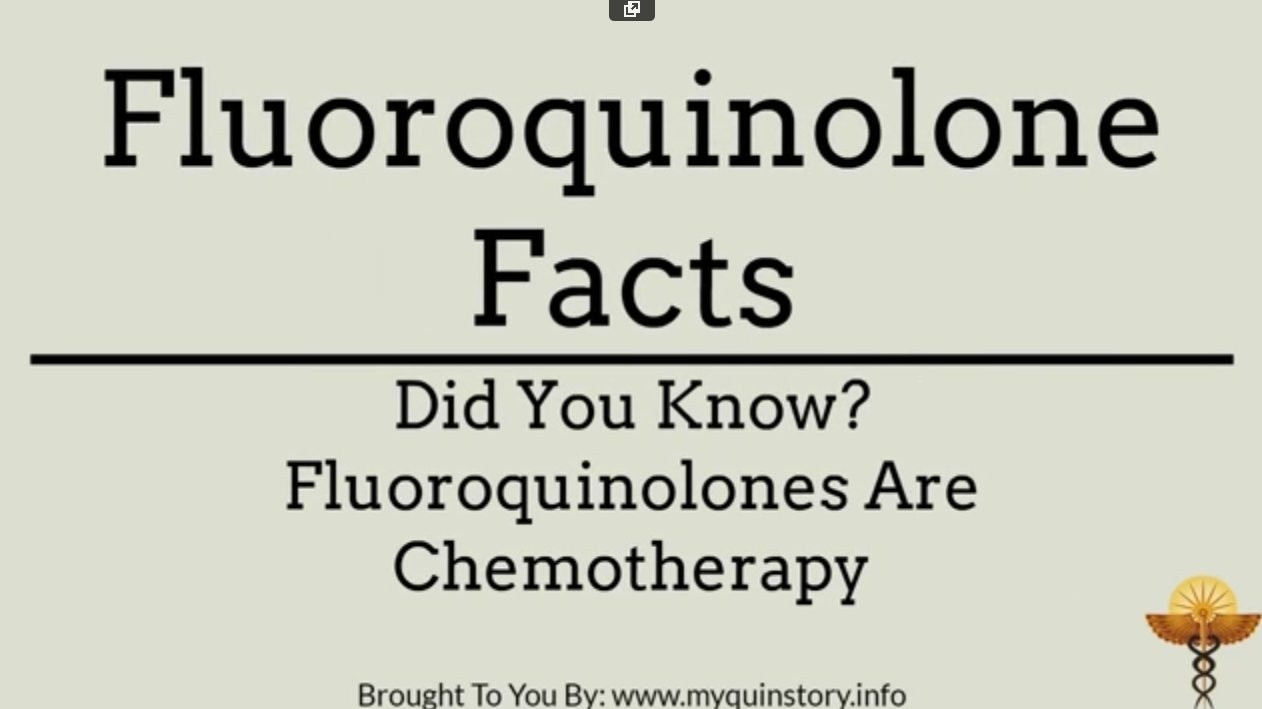
Thank you for watching this video. The following is a list of links to materials documenting the data presented in this video.
Fluoroquinolones damage mammalian mitochondrial DNA via Topoisomerase II:
http://molpharm.aspetjournals.org/content/50/5/1178.long
This article states “These results suggest that ciprofloxacin may be causing cytotoxicity by interfering with a mitochondrial topoisomerase II”
https://www.ncbi.nlm.nih.gov/pmc/articles/PMC3760005/
This article states “quinolones target bacterial gyrases (34) and mtDNA topoisomerases (15),”
Quinolones and damage mammalian mitochondrial DNA:
FDA’s April 27, 2013 Pharmacovigilance Review, where the FDA notes that the mechanism for action through which fluoroquinolones induce peripheral neuropathy is mitochondrial toxicity.
Fluoroquinolones as adjunct to chemotherapy:
http://infectagentscancer.biomedcentral.com/articles/10.1186/1750-9378-7-33
http://www.nature.com/bjc/journal/v95/n8/full/6603355a.html
https://www.ncbi.nlm.nih.gov/pubmed/10414727
Fluoroquinolone based chemotherapy agents:
https://pubmed.ncbi.nlm.nih.gov/28504025/
Antitumor Power of The Quinolone Antibiotics
https://www.ncbi.nlm.nih.gov/pmc/articles/PMC4997924/
Article states “quinolones having significant potency against eukaryotic Type II topoisomerases (topo II)”
https://www.ncbi.nlm.nih.gov/pmc/articles/PMC5745469
Ubiquitous Nature of Fluoroquinolones: The Oscillation between Antibacterial and Anticancer Activities
Fluoroquinolones described as chemotherapy
http://pharmaxchange.info/press/2011/05/mechanism-of-action-of-quinolones-and-fluoroquinolones/
“Late Effects” of chemotherapy
http://www.cancer.net/survivorship/long-term-side-effects-cancer-treatment
http://www.mayoclinic.org/diseases-conditions/cancer/in-depth/cancer-survivor/art-20045524
http://ww5.komen.org/BreastCancer/LongTermSideEffectsofChemotherapy.html

Every once in a while I get the dubious honor of talking to a doctor who has been floxed. This conversation was a poignant example of dangerous the FQ’s are in our society

Floxies are all poster children for peroxidation of cellular and mitochondrial lipids then subsequent damage to proteins and DNA.

One culprit that is often overlooked in chronic Fluoroquinolone toxicity is small intestinal bacterial overgrowth, or SIBO.

I believe that metabolomics is going to open a door for giving us insight into chronic fluoroquinolone toxicity and provide insight into treatment options for those chronically suffering.

If doctors and politicians only see the watered down messages they will not be motivated to change the status quo and more than likely it will be perpetuated indefinitely.
This is a good high profile opportunity for us to continue to warn the general public, family and friends about the dangers posed by the Fluoroquinolones.

One hundred patients who went to the Emergency Room and received a Fluoroquinolone were studied, in ninety nine of those cases, errors were made with the Fluoroquinolone!

I am ecstatic about the new label changes. But given the FDA’s past track record, I will not happy until every medical professional, who has the ability to prescribe a FQ, is familiar with the label changes and safety precautions.